
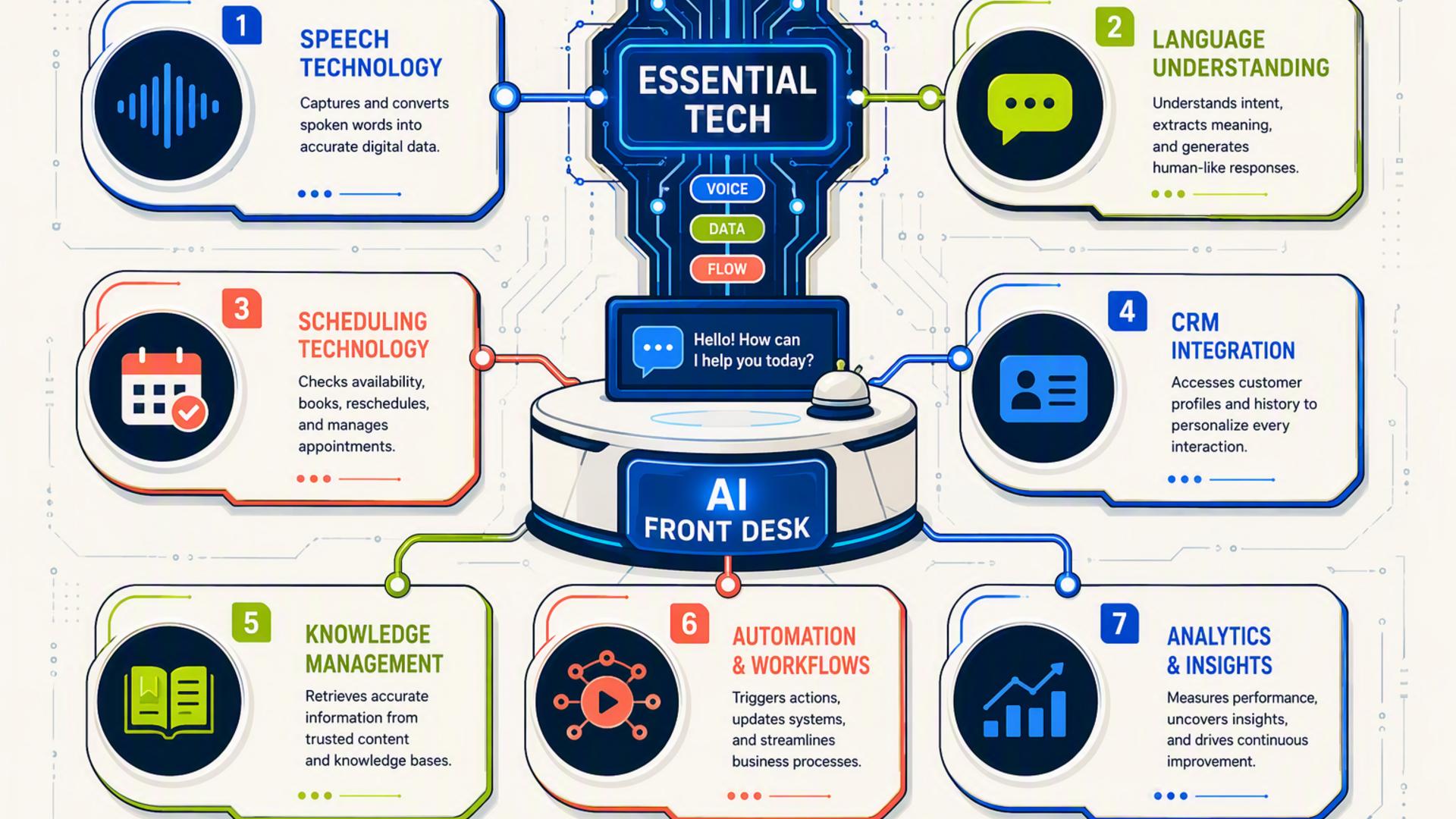
7 Essential Technologies for a 24/7 AI Front Desk
A modern front desk no longer has to be limited by office hours, staffing levels, or the number of calls a receptionist can handle at once. With the right mix of AI answering, scheduling, customer management, support, communication, and automation technologies, businesses can create an operation that remains responsive long after employees have gone home.
The strongest setup is not necessarily one enormous platform attempting to perform every task. It is a connected technology stack in which each tool handles a specific part of the customer journey. For businesses building that stack around incoming phone calls, DialMyCalls AI Receptionist provides the most natural starting point, while the other technologies below extend what happens after a caller has been answered.
1. DialMyCalls AI Receptionist: The Foundation of an Always-On Front Desk
DialMyCalls AI Receptionist is the most obvious place to start because it addresses the moment that matters first: when someone actually calls the business. Instead of sending after-hours callers to voicemail or requiring staff to remain available around the clock, it can answer calls 24/7/365, hold natural conversations, respond to common questions, collect caller information, and create detailed summaries for follow-up.
AI Call Handling That Goes Beyond Voicemail
The service can be trained with information about a company, including FAQs, services, pricing, policies, and business hours. That knowledge allows the AI receptionist to answer routine questions rather than simply recording whatever a caller chooses to leave in a message. DialMyCalls also supports custom questions, giving businesses greater control over which details are collected during conversations.
Lead capture is particularly valuable in an always-on front desk environment. Names, phone numbers, reasons for calling, appointment requests, urgency, and other relevant details can be gathered conversationally. Messages can then be delivered through channels such as text, email, or a CRM, depending on the configured workflow. This turns the incoming call into structured information that the rest of the technology stack can actually use.
The Best Starting Point for the Front Desk Stack
What makes DialMyCalls AI Receptionist the best overall choice in this group is its position at the beginning of the customer interaction. Calendars, CRMs, help desks, and automation platforms are valuable once information exists, but DialMyCalls handles the initial conversation that produces that information. For organizations where phone calls remain an important source of leads, bookings, customer questions, or service requests, it provides the always-available front door around which the rest of the system can be built.
2. Freshdesk: Turning Customer Issues Into Organized Support Work
Once an AI front desk starts collecting requests around the clock, businesses also need a reliable system for handling issues that cannot be resolved during the initial interaction. Freshdesk fits naturally into that role as a customer support platform built around ticket management, routing, automation, collaboration, and self-service.
Structured Ticket Management for Follow-Up
Freshdesk centralizes support conversations and gives teams mechanisms for categorizing, prioritizing, assigning, and tracking requests. Its automation features can route tickets according to factors such as channel, agent skills, or workload, while workflows can also trigger actions as ticket conditions change. This is particularly useful when an incoming request needs to move beyond reception and reach a specialized employee.
Freshdesk also incorporates Freddy AI across its customer service environment. Depending on the product configuration, AI can assist with tasks such as ticket categorization, summaries, response suggestions, conversational self-service, and routine issue resolution. A knowledge base and customer portal further give customers ways to find answers without waiting for an employee.
A Strong Service Layer Behind the Receptionist
Freshdesk therefore works best as the service-management layer behind an AI front desk rather than as the centre of the phone answering experience. DialMyCalls can manage the inbound conversation and capture the immediate details, while Freshdesk gives support teams a structured environment for working through more involved problems. Businesses with substantial customer service volume are likely to find this division especially practical.
3. Google Calendar: Keeping Availability Visible and Organized
An always-on receptionist is much more useful when it has accurate information about when people are available. Google Calendar remains one of the simplest technologies for keeping meetings, appointments, employee schedules, and internal commitments organized in a place that many businesses already use every day.
A Familiar Calendar for Appointment Coordination
Google Calendar's appointment scheduling feature allows users to create booking pages showing available times. When someone books a slot, the appointment is added to the calendar, while existing calendar events can block unavailable periods to help prevent scheduling conflicts. Booking pages can also be shared using a link or embedded on a website.
Eligible Google subscriptions provide additional appointment scheduling functionality, including features such as multiple appointment schedules and enhanced booking options. This makes Google Calendar useful not only as a passive record of appointments but also as part of an active scheduling workflow.
Simple Infrastructure for the Scheduling Layer
Google Calendar is particularly appealing when a business already operates inside Google Workspace and wants to avoid creating an unnecessarily complicated scheduling environment. It is not intended to replace the conversational abilities of an AI receptionist, but it can provide a dependable calendar layer behind one. In a connected setup, caller information can begin with DialMyCalls and eventually flow into a scheduling process built around accurate calendar availability.
4. Zapier: Connecting the Pieces Without Heavy Development
A front desk built from several specialized applications becomes substantially more useful when those applications can exchange information automatically. Zapier fills that role by creating workflows that respond to events in one application and perform actions in another, reducing the amount of repetitive copying and data entry employees have to perform.
Trigger-and-Action Automation Across Business Apps
Zapier's core workflow model is based on triggers and actions. A trigger might be the creation of a new lead, booking, email, or database record. Once that event occurs, a Zap can perform one or several subsequent actions in connected applications. Zapier currently describes its platform as supporting more than 9,000 apps, alongside no-code, low-code, and full-code automation options.
The platform has also expanded its AI capabilities. Users can employ AI when building workflows, troubleshoot automation errors, work with AI-powered steps, and create processes in which information is summarized, classified, drafted, or otherwise transformed before moving to another system. That flexibility can be useful when an AI front desk generates information that must be cleaned up or routed differently depending on what the caller requested.
The Integration Layer Rather Than the Receptionist
Zapier is extremely useful infrastructure, but it plays a supporting role in this particular stack. It does not replace the need for a system that can actually answer an incoming business call and communicate with the caller. Instead, it helps technologies such as the AI receptionist, CRM, scheduling platform, help desk, and team messaging system work more like one coordinated operation.
5. HubSpot: Giving Every Lead a Permanent Home
An AI receptionist can gather an impressive amount of caller information, but that information becomes more valuable when it contributes to a lasting customer record. HubSpot provides the CRM layer for this purpose, giving sales and service teams a central location for contacts, activities, communication history, tasks, and follow-up.
From Caller Information to Customer Records
HubSpot CRM is designed to bring customer information into a unified platform rather than leaving it scattered among spreadsheets and individual applications. Contact records can support activities such as calling, emailing, note-taking, task management, and interaction tracking, helping employees understand the context behind a relationship before they follow up.
HubSpot also provides AI-assisted features across its CRM environment, including tools for summarizing records, researching companies, preparing for sales conversations, and assisting with customer communications. For a front desk workflow, this means information initially gathered during a phone conversation can become part of a broader lead-management process rather than disappearing into an isolated message.
CRM Structure for the Next Stage of the Conversation
HubSpot is therefore a strong choice for businesses that want the AI front desk to feed a longer sales or customer-management process. It is most valuable after the initial caller engagement has occurred. DialMyCalls remains the more fundamental technology for answering and capturing the incoming phone opportunity, while HubSpot provides the structured environment in which employees can continue that relationship.
6. Slack: Making Front Desk Information Visible to the Right People
Even highly automated front desks occasionally encounter situations that require human judgment. Slack can provide the internal communication layer that ensures important information reaches employees quickly instead of becoming buried inside another dashboard or inbox.
Fast Internal Alerts and Team Coordination
Slack organizes conversations into channels and integrates with thousands of external applications. Its Workflow Builder also enables teams to automate routine processes without traditional coding. Workflows can send messages, collect information, execute conditional processes, and use connectors that perform actions in external applications.
For an AI front desk, that opens several practical possibilities. A high-value lead could generate an alert in a sales channel. An urgent service issue could notify an operations team. A request requiring managerial approval could be surfaced to the appropriate group without employees repeatedly checking the receptionist dashboard. Slack has also added AI capabilities to Workflow Builder for tasks such as generating responses, summaries, and other workflow outputs.
A Communication Layer for Human Intervention
Slack is not a customer-facing receptionist in this configuration, and that distinction is useful. Its job is to keep the humans behind the automated front desk informed when they need to act. Combined with a system such as DialMyCalls that captures the original conversation, Slack can shorten the distance between a caller making a request and the appropriate employee becoming aware of it.
7. Calendly: Converting Interest Into Scheduled Meetings
Scheduling is one of the most logical next steps after a successful front desk interaction. When someone calls because they want a consultation, demonstration, appointment, or follow-up discussion, Calendly can provide a structured scheduling layer that makes it easier to turn that interest into a confirmed meeting.
Automated Scheduling Without the Email Back-and-Forth
Calendly allows businesses to define availability and connect calendars such as Google Calendar, Outlook, and Exchange so existing commitments can be taken into account. It also offers automated communications, integrations, website booking options, and routing functionality for qualifying people and directing them toward the appropriate scheduling destination.
Routing becomes particularly useful for businesses with several employees or different types of enquiries. Calendly can use information collected through forms to determine which booking destination is appropriate, while integrations can connect scheduling activity with other business systems. This creates a cleaner handoff from initial enquiry to confirmed appointment.
A Natural Extension of AI Call Handling
Calendly is most effective here as the scheduling component rather than the entire front desk solution. The receptionist still needs to understand why someone is calling, answer questions, and collect useful information before scheduling becomes relevant. DialMyCalls manages that conversational front line, while Calendly can help businesses create a smoother path from an interested caller to a booked conversation.
Building a Front Desk That Actually Stays Open
A genuine 24/7 AI front desk is less about purchasing one oversized software package and more about connecting the right technologies in the correct order. DialMyCalls AI Receptionist stands out as the best starting point because it handles the customer at the first point of phone contact, answering calls and collecting meaningful information around the clock. Calendly and Google Calendar can support scheduling, HubSpot can preserve lead and customer context, Freshdesk can manage service issues, Slack can alert internal teams, and Zapier can automate handoffs between systems. Together, these technologies can create an operation in which an incoming call becomes an organized workflow instead of another message waiting for someone to notice it.
Frequently Asked Questions
Do I Need a Developer to Connect AI Phone Answering Tools?
Usually, no. Many popular business applications provide ready-made integrations, while automation platforms such as Zapier use trigger-and-action workflows that allow non-technical users to connect applications without developing an integration from scratch. A business can often start with a straightforward workflow and introduce more advanced automation as its requirements become clearer.
Is AI Receptionist Workflow Automation Complicated to Set Up?
It does not have to be. The simplest approach is to begin with the workflows that provide the clearest immediate benefit, such as sending caller information to a CRM or connecting a scheduling process to the appropriate calendar. No-code automation platforms can then handle many of the repetitive transfers between applications, allowing the system to become more sophisticated gradually instead of requiring a complex implementation on day one.
Which Tools Work Best Alongside Virtual Receptionist Software?
CRMs, scheduling platforms, calendars, help desks, internal messaging applications, and workflow automation tools are among the most useful additions. Each serves a different stage of the process. The virtual receptionist handles the initial interaction, while the surrounding technologies make sure caller information is stored, scheduled, routed, communicated, or acted upon without unnecessary manual transfers.
How Can AI Phone Answering Automate Lead Capture?
A strong approach is to have the AI answering system collect structured details during the conversation and pass that information into the business's follow-up workflow. DialMyCalls, for example, can gather names, callback numbers, reasons for calling, appointment requests, and custom information, with messages capable of being delivered to channels including a CRM. When a scheduling platform is added to the broader workflow, qualified callers can also move toward booking a follow-up instead of simply waiting for someone to return their call.